
SEO-Friendly URLs and Slugs for Dental Practices
Your website’s URLs might look harmless — but if they’re long, messy, or full of random numbers, they’re quietly sabotaging your SEO.
Google uses your URLs to understand your site’s structure, and patients use them to decide whether to click.
A clean, keyword-rich URL tells both audiences, “This page is relevant, trustworthy, and worth visiting.”
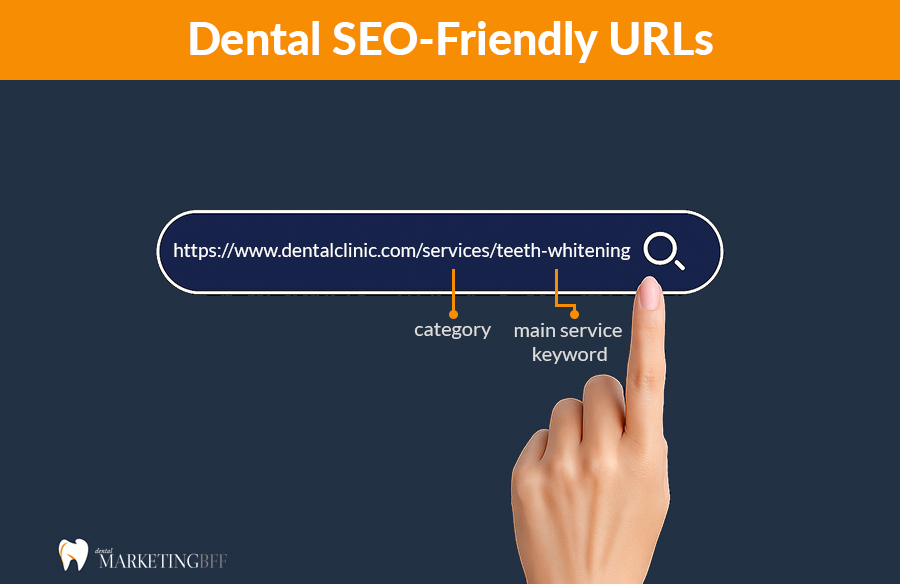
Let’s talk about how to create SEO-friendly URLs and slugs that help your dental website rank higher, look professional, and drive more clicks.
Key Takeaways
- Keep URLs short, descriptive, and keyword-rich.
- Use lowercase letters and hyphens (never underscores).
- Include target keywords and your location when relevant.
- Avoid numbers, special characters, and dynamic parameters.
- Clear URLs improve both rankings and user trust.

See How Our Agency Can Help You Attract More Patients
- SEO — dominate Google and Local Map searches.
- Website Design — convert traffic into booked appointments.
- Content Marketing — we create content that gets traffic.
Why SEO-Friendly URLs Matter for Dentists
A well-structured URL isn’t just about looks — it’s an SEO signal.
Google uses URLs to determine how pages relate within your site’s hierarchy. Patients scan them in search results to gauge relevance. Compare these two examples:
❌ www.dentalclinic.com/page.php?id=3921
YES: www.dentalclinic.com/services/teeth-whitening/
Which one instantly communicates what the page is about?
Exactly.
SEO-friendly URLs help you:
- Improve click-through rate (CTR) from search results
- Build trust with users
- Strengthen topical relevance for target keywords
- Make your website easier to crawl and index
Your URL strategy should reflect a logical, easy-to-crawl layout. If you need help planning that, read SEO Website Structure for Dental Clinics.
How Google Reads URLs
Googlebot crawls your site and uses your URLs to determine topic and hierarchy. Clean URLs help it group related pages (e.g., services, locations, blogs) and understand your content clusters.
A logical slug structure like this tells Google your site is organized:
/dental-services/pediatric
/dental-services/restorative/dental-implants/
/dental-services/implants/full-arch/
The “parent-child” relationship between URLs boosts contextual authority — one reason the silo structure works so well in SEO.
Clean, consistent slugs make your internal links clearer and more powerful. See how to use them strategically in How to Use Internal Links to Boost Dental SEO.
Anatomy of an SEO-Friendly Dental URL
A good URL is short, readable, and descriptive. Here’s the formula: domain.com/category/keyword/
Example: yourdomain.com/services/invisalign/
That simple slug tells Google (and the patient):
– This is a service page
– The service is Invisalign
– The content is relevant to dental patients
For even better results, line up your URLs with optimized titles and descriptions from How to Write Meta Titles and Descriptions for Dentists.
6 Rules for SEO-Friendly URLs
Let’s break down the essential best practices:
1. Keep URLs Short and Simple
Google prefers URLs under 60 characters. Shorter URLs rank better and are easier to share or remember.
Good: /dental-implants-gilbert/
Bad: /services/dental-implant-replacement-and-restoration-gilbert-arizona/
2. Use Hyphens, Not Underscores
Hyphens act as spaces between words. Underscores (_) don’t.
Example:
YES: /teeth-whitening/
❌ /teeth_whitening/
Google reads “teeth-whitening” as two words but “teeth_whitening” as one long string.
3. Include Keywords Naturally
Don’t stuff every keyword you can think of. Use one or two primary phrases that reflect what’s on the page.
Example:
YES: /dental-veneers-queen-creek/
❌ /veneers-dentist-dental-teeth-cosmetic-queen-creek-az/
4. Use Lowercase Only
URLs are case-sensitive. If you mix upper and lowercase letters, you can accidentally create duplicate URLs.
Always use lowercase for consistency and simplicity.
5. Avoid Stop Words
Words like “the,” “and,” or “of” don’t add SEO value. Drop them unless they’re part of a proper name or keyword phrase.
YES: /family-dentist-gilbert/
❌ /the-best-family-dentist-in-gilbert/
6. Don’t Change URLs Often
Once a URL is live, keep it. Frequent changes cause broken links, redirect loops, and lost rankings. If you must update it, use a 301 redirect to preserve SEO equity.
The Perfect URL Structure for a Dental Website
Here’s a proven structure that helps Google (and patients) navigate your site:
| Page Type | Example URL | Notes |
| Homepage | / | Keep simple |
| Service Page | /services/teeth-whitening/ | Main service keyword |
| Location Page | /locations/gilbert/ | For local SEO |
| Blog Post | /blog/how-to-improve-your-smile/ | Descriptive title |
| About Page | /about/ | One word is fine |
| Contact Page | /contact/ | Consistent with menu |
Advanced Tip: Add Breadcrumbs for Better UX
Breadcrumb navigation (e.g., “Home › Services › Invisalign”) helps users and search engines understand where they are. It also improves how your URLs display in Google search results.
Tools to Create and Audit SEO-Friendly URLs
- Yoast SEO or Rank Math: Helps you edit slugs in WordPress
- Ahrefs Site Audit: Detects duplicate or broken URLs
- Screaming Frog: Maps all internal URL structures
Run these quarterly to keep your site clean and consistent.
Common URL Mistakes Dentists Make
❌ Using IDs or query parameters (e.g., ?pageid=1274)
❌ Capital letters or underscores
❌ Changing URLs without redirects
❌ Stuffing too many keywords
❌ Including dates in URLs (e.g., /2023/teeth-whitening/)
Each mistake dilutes SEO equity and makes pages harder to find — both for Google and for patients.
FAQs
Conclusion: Clean URLs Build Stronger SEO (and Trust)
Your URLs might be small details, but they make a big impact on how Google and patients perceive your site. A clean, keyword-rich structure communicates relevance, professionalism, and trust — all while helping your pages rank higher and load faster.
When every link on your site is short, consistent, and descriptive, you’re not just improving SEO — you’re building a smoother experience that converts more visitors into patients.
Ready to clean up your dental website’s URLs and boost your rankings? Book a Free Dental SEO Strategy Call →
