
How to Use Internal Links to Boost Dental SEO
Your website might be full of amazing dental content — but if it’s not properly connected, Google can’t see the big picture.
That’s where dental internal linking comes in.
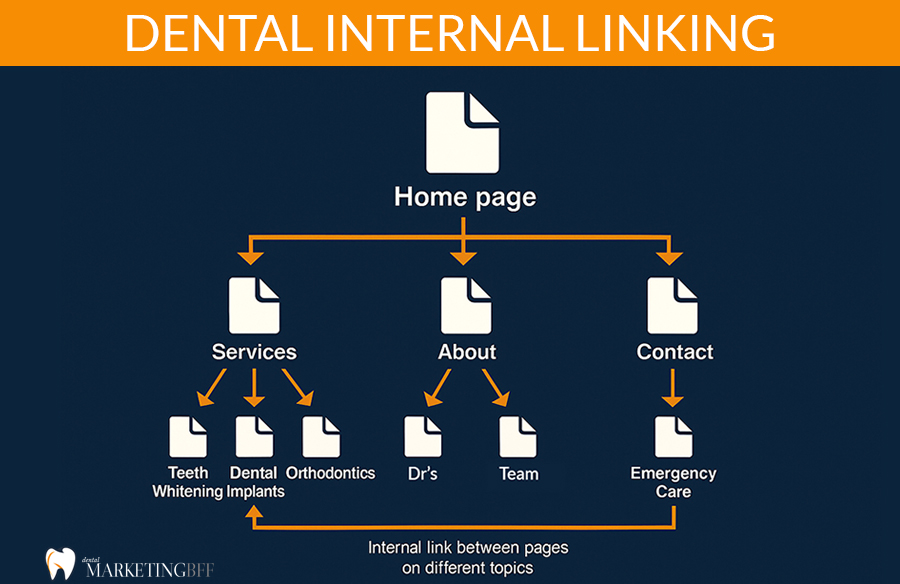
Think of internal links as your website’s nervous system. They help Google discover, understand, and rank your content while guiding patients to book appointments faster.
Done right, internal linking can dramatically improve your keyword visibility and SEO performance — without creating new content.
Let’s explore exactly how to use internal links to strengthen your Dental SEO strategy.
Key Takeaways
- Internal links guide Google through your site and pass authority between pages.
- Use keyword-rich anchor text to signal topic relevance.
- Every service page and blog post should link up to your pillar pages.
- Avoid overlinking; quality and context matter more than volume.
- Strong internal links improve rankings, crawl efficiency, and conversions.

See How Our Agency Can Help You Attract More Patients
- SEO — dominate Google and Local Map searches.
- Website Design — convert traffic into booked appointments.
- Content Marketing — we create content that gets traffic.
Why Internal Linking Matters for Dental SEO
Internal links are clickable text links from one page on your website to another. They serve two essential purposes:
- SEO: They help Google understand which pages are most important and how they relate.
- User Experience: They guide patients to relevant services, blog posts, or FAQs.
Google’s crawler, called Googlebot, follows links to discover and index pages. When your website has a clear linking structure, it tells Google which pages deserve the most visibility — typically your service and location pages.
How Google Uses Internal Links
When Google crawls your site, it assigns more value to pages that receive links from other high-authority pages. This process is called link equity, or “PageRank flow.”
Example:
If your homepage links to your “Dental Implants” page, and that page links to a “Dental Implants Cost Guide,” Google understands both are connected and valuable.
That’s why internal links are often more powerful than backlinks — because you control them.
Internal links are most powerful when your structure is intentional. If you haven’t mapped that out yet, start with SEO Website Structure for Dental Clinics.
The Ideal Internal Linking Structure for Dental Websites
Most dental sites should follow this hierarchy:
Homepage → Main Services & Location Pages
Service Pages → Blog Posts & FAQs
Blog Posts → Service Pages & Pillars
Pillar Pages → Category Subtopics
This structure creates a “silo” system where content clusters around key topics like:
- /dental-services/dental-implants/
- /dental-services/emergency-care/
- /dental-services/dental-bridges/
Best Practices for Internal Linking
1. Use Keyword-Rich Anchor Text
Your anchor text (the clickable part) tells Google what the linked page is about.
Example:
YES: Learn more about our teeth whitening services.
❌ Click here to learn more.
Avoid over-optimization by varying your phrases:
- “cosmetic dentist in Gilbert”
- “professional teeth whitening options”
- “our smile transformation treatments”
Your links work even harder when URLs are clean and descriptive. Learn how to fine-tune those in SEO-Friendly URLs and Slugs for Dental Practices.
2. Link to High-Value Pages
Not every page needs equal visibility. Your most important links should go to:
- Service pages
- Location pages
- Blog posts that drive traffic or conversions
- The Dental SEO pillar page (/dental-seo/)
3. Keep Links Contextual
Links within body content carry more weight than footer or sidebar links. If you’re writing about teeth cleaning, link naturally to your preventive care page — not randomly to Invisalign.
4. Avoid Orphan Pages
An orphan page has no internal links pointing to it. If Google can’t find it through a link, it might as well not exist.
Use a site crawler (like Screaming Frog or Ahrefs) to identify and fix orphan pages.
5. Limit the Number of Links per Page
Too many links dilute authority. Aim for:
- 2–4 links per 500 words of content
- 5–8 internal links total per page
Focus on relevance — only link when it makes sense contextually.
Internal Linking for Blog Posts
Your blog posts are SEO goldmines, but only if they connect strategically. Here’s how:
- Link every blog post to a pillar page (like /dental-services/).
- Cross-link related articles (e.g., “keyword research” → “dental implants”).
- Use contextual CTAs like:
“Curious if you should have a dental implant or dental bridge to replace a single missing tooth? Check out our Dental Implants vs Bridges guide.”
This network effect signals authority and keeps users exploring your site longer — which also improves engagement metrics Google watches closely.
Internal Linking Tools You Can Use
- Yoast SEO Premium → Suggests internal links automatically.
- Link Whisper → AI-based tool that identifies linking opportunities.
- Ahrefs Site Audit → Finds broken or missing links.
Common Internal Linking Mistakes
❌ Linking only to the homepage
❌ Using generic anchor text (“read more”)
❌ Creating broken links after URL changes
❌ Forgetting to link back up to pillar content
❌ Overstuffing links on one page
Audit your internal link structure every quarter to maintain clarity and equity flow.
Advanced: Use Breadcrumbs for Navigation
Breadcrumbs are secondary navigation links (usually at the top of a page) showing where users are within your site.
Example: Home › Dental SEO › Website Optimization › Internal Linking
They help users backtrack easily — and they also improve crawlability and CTR in Google’s search snippets.
Internal Linking = SEO ROI
Here’s what happens when you do this right:
- Crawl Depth: Google reaches all pages efficiently.
- Keyword Relevance: Topical clusters build authority.
- Conversion Paths: Users find your booking or contact forms faster.
We’ve seen dental clients increase organic traffic by 40% and conversion rates by 25% just by restructuring internal links — no new content required.
When you combine smart linking with strong on-page elements, you end up with a truly optimized site. See what that looks like in What Makes a Dental Website SEO-Friendly.
FAQs
Conclusion: Connect Your Content, Strengthen Your SEO
Internal links are the bridges that guide both Google and your patients through your website. When each page connects logically and strategically, you boost visibility, authority, and patient engagement — all without writing a single new word.
By building a clear linking structure, using keyword-rich anchors, and eliminating orphan pages, you turn your existing content into a cohesive network that ranks higher and converts better.
Ready to see how strategic internal linking can transform your Dental SEO? Book a Free Dental SEO Strategy Call →
