
How to Write SEO-Friendly Blog Posts for Dentists
You can write the most beautiful, heartfelt blog post in the world — but if it’s not optimized for SEO, almost no one will ever see it.
That’s the harsh truth. Google doesn’t automatically reward good writing. It rewards well-structured, optimized content that matches search intent and makes readers stay.
So, if you’ve ever written a post that fell flat in search results, this guide will show you exactly how to fix it.
Let’s break down how to write SEO-friendly blog posts for dentists — posts that rank, attract patients, and build authority for your practice.
Key Takeaways
- SEO-friendly blogs combine keyword research, structure, and engagement.
- Write for humans first, optimize for Google second.
- Each post should have one main keyword and a few supporting terms.
- Headings, internal links, and alt text all help your SEO.
- Great blogs convert readers into new patient appointments.

See How Our Agency Can Help You Attract More Patients
- SEO — dominate Google and Local Map searches.
- Website Design — convert traffic into booked appointments.
- Content Marketing — we create content that gets traffic.
Why SEO-Optimized Blogging Is Essential for Dentists
Blogging is how Google learns who you are and what you do.
When done right, SEO blogging can help you:
- Rank for long-tail keywords like “how much does Invisalign cost in Gilbert.”
- Earn backlinks from relevant sites.
- Build E-E-A-T (Experience, Expertise, Authority, Trustworthiness).
- Capture patients earlier in their research phase.
A blog turns your website from a digital brochure into a patient magnet.
Step 1: Do Keyword Research Before You Write
SEO-friendly writing starts before you open Google Docs.
How to Find Blog Keywords:
- Use Ubersuggest or Ahrefs: Search terms like “dentist,” “teeth cleaning,” or “dental implants.”
- Look for long-tail keywords: These are 3–5 word phrases with specific intent (e.g., “teeth whitening near me cost”).
- Check Google’s “People Also Ask” boxes: Instant inspiration for blog questions.
- Use Search Console: Look for keywords your site already ranks for on page 2 — those are your quick wins.
Example:
Let’s say you want to write about veneers. Instead of “veneers,” which is too broad, you might target:
- “porcelain veneers cost in Gilbert”
- “veneers vs crowns difference”
- “how long do veneers last”
Each of those can become its own SEO-optimized blog post.
Before you begin writing, build your outline around the right terms. Use How to Do Keyword Research for Dental Services to choose your targets.
Step 2: Nail Your Title and Meta Description
Your title and meta description are what convince someone to click.
Formula for SEO Titles: Keyword + Emotion + Benefit
YES: “Teeth Whitening Options for a Brighter Smile in Gilbert”
❌ “Teeth Whitening Info”
Meta Description Tip: Keep it under 160 characters and include your focus keyword naturally.
Example: “Discover how professional teeth whitening in Gilbert can safely brighten your smile and improve confidence.”
Step 3: Use an SEO-Friendly Blog Structure
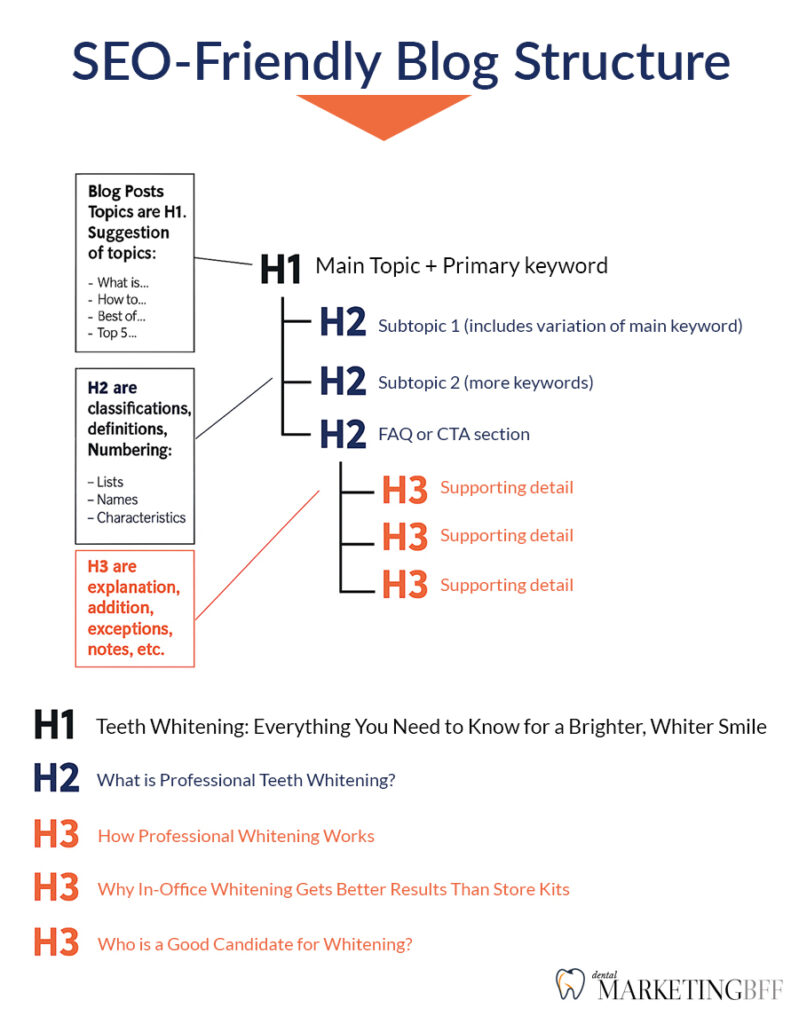
Google reads structure before it reads sentences.
Here’s the ideal format for a dental SEO blog:
H1: Main Keyword (used once)
Intro: 2–4 short paragraphs
H2: Subtopic 1 (includes variation keyword)
H3: Supporting detail
H2: Subtopic 2 (more keywords)
H2: FAQs or CTA section
This makes it easy for both readers and Google to navigate.
Step 4: Write for Humans, Not Robots
Gone are the days of stuffing “dentist Gilbert” into every other sentence.
Google’s algorithm now measures helpfulness and user engagement.
Your blog should sound conversational and empathetic — like you’re explaining something to a friend, not writing a research paper.
Example Rewrite:
❌ “Teeth whitening Gilbert AZ dentist teeth whitening professional services are best.”
YES: “If you’re looking for a dentist in Gilbert who offers professional teeth whitening, here’s what you should know before you book.”
Same keyword, but much more natural — and far more likely to rank.
Step 5: Add Internal Links
Every blog you write should link to:
- Your core service pages (e.g., /services/teeth-whitening/)
- Your pillar keyword page (/gilbert-dentist/)
- Other related blog posts for depth
Example: “Learn how to structure your website for SEO success → /dental-seo/website-optimization/seo-friendly-dental-website/”
Internal links help search engines understand your site’s hierarchy and spread “link juice” between posts.
Once you’ve written your draft, use internal links to strengthen your blog’s topical authority — here’s how to do it right: How to Use Internal Links to Boost Dental SEO.
Step 6: Use Images and Alt Text
Images make posts more engaging — but they also need optimization.
Alt Text Rule: Describe the image using a keyword when relevant. For example: “Before-and-after dental cleaning at a Gilbert dentist office.”
Also compress large images (under 200KB) for faster loading.
Step 7: Add Schema Markup
Schema helps Google understand what your content is about.
Adding FAQ schema to blog posts can help you appear in rich snippets — those expandable question boxes on Google.
If you use WordPress, plugins like Rank Math or Yoast make this easy.
Step 8: Optimize for Local Intent
For dental blogs, local relevance is key. Mention your city and service area naturally throughout your post.
Example: “Our Gilbert dental team often helps patients wondering whether Invisalign is right for them.”
This helps you rank for both national and local searches.
If you want your blog posts to truly satisfy Google’s expectations, review Understanding Search Intent in Dental SEO.
Step 9: End with a Call to Action
Every blog should move readers toward a next step:
- “Schedule your visit.”
- “Download our guide.”
- “Call today for a consultation.”
Example CTA:
Ready for a brighter, healthier smile? Book your cleaning today.
Blogs that include clear CTAs can convert up to 3x better than those that don’t.
Step 10: Update Old Posts
Google loves fresh content. Update old posts every 6–12 months to add new stats, links, and insights.
When updating:
- Change the date in your CMS.
- Add one or two new internal links.
- Refresh visuals and FAQ sections.
This simple habit helps maintain steady rankings over time.
Advanced Tips for SEO-Friendly Dental Blogs
–Use Featured Snippets to Your Advantage
Start sections with short, clear definitions that answer questions concisely — perfect for AI Overviews and “People Also Ask.”
–Include Local Schema
Identify your location in structured data so Google knows your service area.
–Repurpose Blogs into Short-Form Content
Turn snippets into Google Business posts or Instagram captions to extend their reach.
–Encourage Backlinks
Promote your best educational posts to schools, blogs, or health directories for citation opportunities.
Common Mistakes in Dental Blogging
❌ Writing too short (under 600 words).
❌ Ignoring search intent.
❌ Failing to include city/location keywords.
❌ Forgetting to optimize meta tags.
❌ Never measuring performance in Google Search Console.
Writing SEO-friendly blogs isn’t about gaming Google — it’s about writing content that patients actually find useful and Google wants to reward.
FAQs
Conclusion: Write with Purpose, Optimize with Strategy
Even the most insightful dental content won’t drive results unless Google can find it — and patients can connect with it. SEO-friendly blogging bridges that gap by blending education, structure, and strategy.
When every post answers real patient questions, uses natural local keywords, and flows with clear headings, images, and links, your content becomes more than words — it becomes an engine for discovery and trust.
Consistently optimized blogs don’t just attract readers — they convert them into loyal patients.
Ready to turn your dental blog into a patient-generating SEO asset? Book a Free Dental SEO Strategy Call →
