
How to Use E-E-A-T to Boost Dental SEO Credibility
If you’ve been wondering why your dental website isn’t ranking — even though it looks great and loads fast — it might not be your design.
It might be your E-E-A-T.
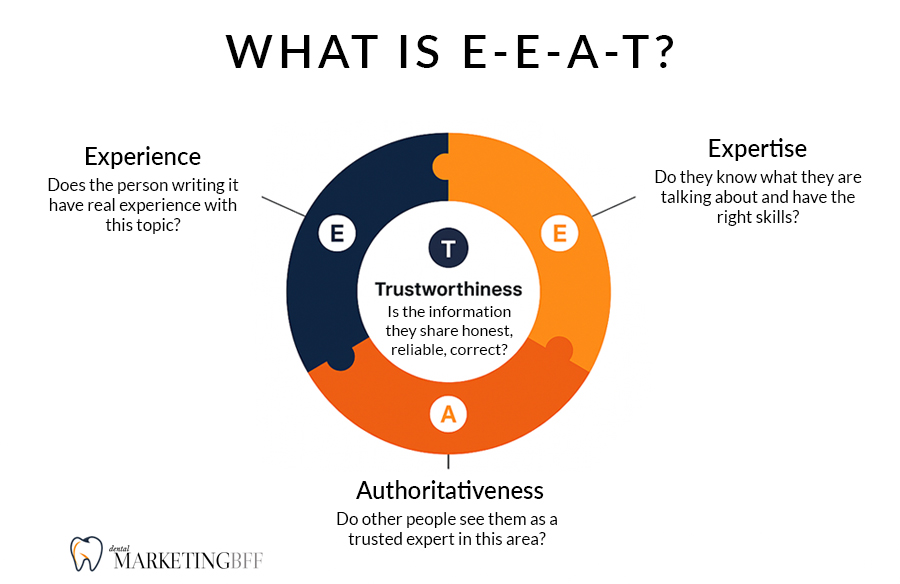
Google’s updated ranking systems no longer just measure keywords and backlinks. They measure how trustworthy and credible your content appears — especially in industries that affect people’s health, happiness, or money.
For dentists, that means E-E-A-T isn’t optional anymore. It’s everything.
Key Takeaways
- E-E-A-T stands for Experience, Expertise, Authority, and Trustworthiness — core ranking factors in Google’s algorithm.
- Dental websites need strong author bios, professional credentials, and transparent information to earn Google’s trust.
- E-E-A-T improves both patient conversions and search visibility.
- You can demonstrate E-E-A-T through content, structure, reviews, and schema markup.
- Implementing E-E-A-T helps you stand out from competitors who rely solely on design.

See How Our Agency Can Help You Attract More Patients
- SEO — dominate Google and Local Map searches.
- Website Design — convert traffic into booked appointments.
- Content Marketing — we create content that gets traffic.
What Is E-E-A-T (and Why It Matters for Dental SEO)?
E-E-A-T stands for:
- Experience — Has the content creator personally used or performed what they’re writing about?
- Expertise — Are they qualified to speak on this topic?
- Authority — Does the site or person have a positive reputation online?
- Trustworthiness — Is the information transparent, accurate, and verifiable?
This framework comes straight from Google’s Search Quality Evaluator Guidelines, the document real human raters use to evaluate search results.
For dentists, E-E-A-T helps Google determine whether you’re a legitimate, reputable professional or just another local listing.
Why E-E-A-T Is Critical in the Dental Industry
Dentistry falls under Google’s “Your Money or Your Life” (YMYL) category — meaning your content impacts people’s health, safety, or finances.
That means Google holds your site to a higher standard than, say, a fashion blog.
Without visible expertise and trust signals, Google won’t risk ranking your site highly.
Here’s what that means in real-world terms:
| E-E-A-T Element | Example on a Dental Site | SEO Impact |
| Experience | Dentist shares real patient cases with photos (with consent) | Boosts authenticity |
| Expertise | DDS/DMD credentials in bios | Strengthens topical authority |
| Authority | Mentions or backlinks from dental associations | Improves domain trust |
| Trustworthiness | Displaying reviews, insurance info, privacy policy | Improves user confidence + ranking signals |
One of the easiest ways to boost authority is to secure high-quality mentions. Learn how inside Off-Page SEO: How to Build Backlinks for Your Dental Website.
The Four Pillars of E-E-A-T for Dentists
Let’s go deeper into each one — and how to implement them effectively.
1. Experience — Show, Don’t Tell
Google wants to see evidence that your insights come from real-world dental experience.
How to demonstrate this:
- Include photos of real patients (with permission).
- Write blog posts that describe your process (“Here’s how we prepare for your first Invisalign fitting”).
- Share “before-and-after” case studies.
- Add short quotes or notes from your hygienists or assistants.
Example:
Instead of writing “We offer dental implants,” say: “Dr. Jensen has placed over 400 dental implants for patients in the Gilbert area, using 3D imaging for precision and comfort.”
If you’re building topical authority through blogs, grab more ideas from Blog Post Ideas That Improve Dental SEO.
2. Expertise — Showcase Your Credentials
Google can’t tell who you are unless you show it clearly.
You need to prove you’re qualified to talk about dental health.
Include these credibility signals:
- Author Bylines: Each blog post should have “Written by Dr. [Name], DDS.”
- Detailed About Page: Highlight certifications, years of experience, and affiliations (ADA, AGD, etc.).
- Citations and Sources: Reference trusted sources like the ADA or Mayo Clinic.
- Consistent NAP Info: Make sure your business name, address, and phone match across every page.
3. Authority — Build Your Digital Reputation
Authority comes from what others say about you online.
Google looks for external signals that your expertise is recognized.
Here’s how to strengthen it:
- Get featured in local publications or dental journals.
- Partner with schools or community events (and earn backlinks).
- Encourage patients to leave detailed Google Reviews.
- Earn backlinks through data-based blog posts and digital PR.
BFF Pro Tip: Use Google Alerts to monitor mentions of your practice name. When you find unlinked mentions, politely ask the author to add a link — an easy E-E-A-T win.
4. Trustworthiness — Build Confidence Through Transparency
Trust is the foundation of both SEO and patient relationships.
When patients feel safe on your site, they’re more likely to book. When Google detects transparency, it’s more likely to rank you.
Checklist for dental trust signals:
– HTTPS security certificate
– Displayed contact info and business hours
– Clear refund/cancellation policies for cosmetic consults
– Published privacy policy
– Third-party review badges (e.g., Healthgrades, Zocdoc)
Add patient perspectives to strengthen E-E-A-T. Use the approaches in How to Use Patient Testimonials in SEO.
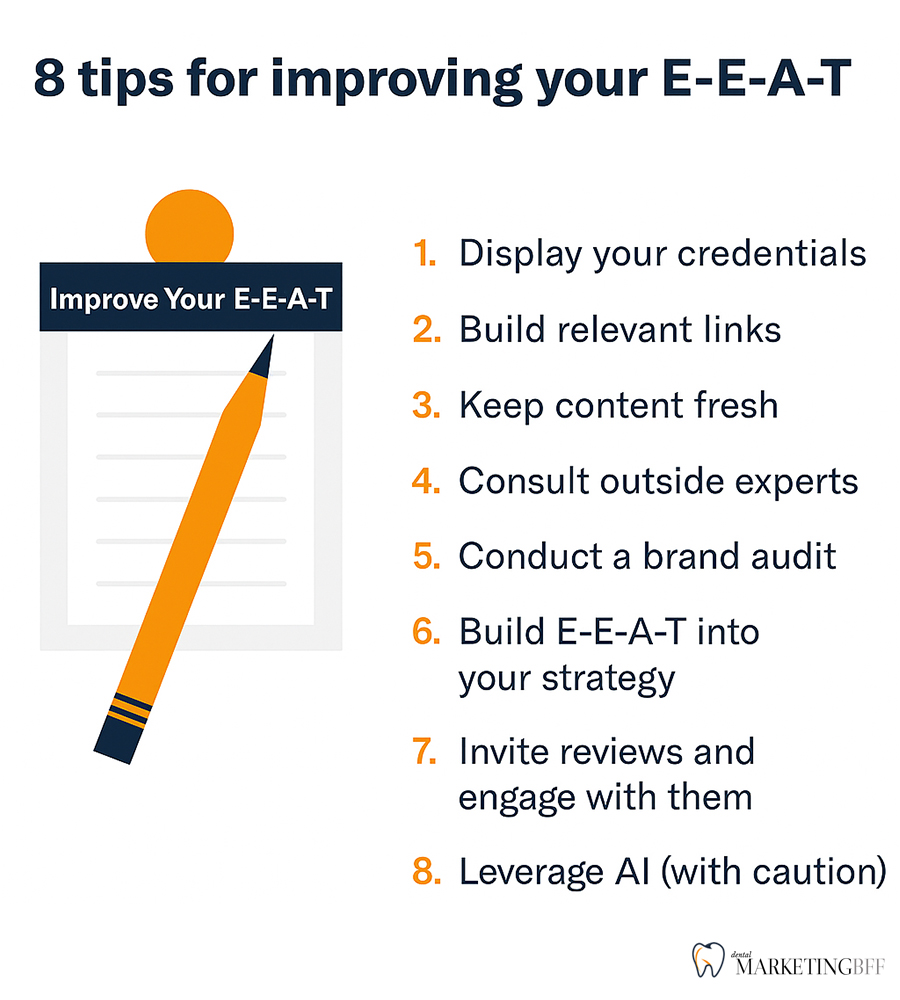
How to Apply E-E-A-T Across Your Website
It’s not enough to “say” you’re trustworthy — you must prove it in your structure, copy, and metadata.
On Your Homepage
- Add a “Meet the Dentist” section.
- Include a clinic photo to establish authenticity.
On Service Pages
- Add FAQs about the treatment process.
- Include staff quotes or “Doctor’s Notes.”
On Blog Posts
- Add author bios with credentials.
- Link out to reputable sources (ADA, CDC).
On About Page
- Highlight awards, certifications, and associations.
- Link to your Google Business Profile for extra verification.
Advanced E-E-A-T Tactics for 2026
– Add Author Schema
Google uses this to connect your content to your credentials.
– Use Review Schema
Displays patient ratings in SERPs — boosting trust and clicks.
– Include Social Proof in Metadata
Mention “Trusted by 1,200+ local patients” in meta descriptions.
– Cite Local Partners
Linking to local news or nonprofit partners reinforces credibility.
– Create a “Dental Insights” Blog Series
Use your name and photo consistently — it builds topical authority.
The E-E-A-T + Conversion Connection
Google’s algorithmic trust and patient trust work hand-in-hand. When your E-E-A-T improves, both your rankings and bookings rise.
Example: A Phoenix cosmetic dentist added bios, case studies, and FAQ schema. In 90 days:
- Organic traffic grew 46%.
- Average time on page rose 38%.
- Appointment conversions increased 21%.
Patients and algorithms want the same thing: reassurance that you’re the real deal.
Common E-E-A-T Mistakes Dentists Make
❌ No author bios or credentials listed.
❌ Generic “About” pages with stock photos.
❌ Outdated or broken links to associations.
❌ No HTTPS or privacy policy page.
❌ Blog content written by unverified ghostwriters.
If your site lacks these, you’re signaling to Google that your content might not be credible.
FAQs
Conclusion: Build Trust, Boost Rankings, and Win Patients with E-E-A-T
Design, keywords, and backlinks matter — but trust is what seals the deal. E-E-A-T is how you prove to Google (and your patients) that you’re not just another dental website — you’re a credible, experienced, and authoritative source they can rely on.
When you highlight real experience, showcase credentials, display genuine reviews, and back it all with transparency, Google rewards you with visibility — and patients reward you with loyalty.
Ready to strengthen your website’s credibility and climb higher in Google? Book a Free Dental SEO Strategy Call →
