
Blogging vs. Service Pages: What Works Better for Dental SEO
Here’s a common question I hear from dentists every single month: “Should I focus on blogging or service pages for SEO?”
The answer? Both — but for very different reasons.
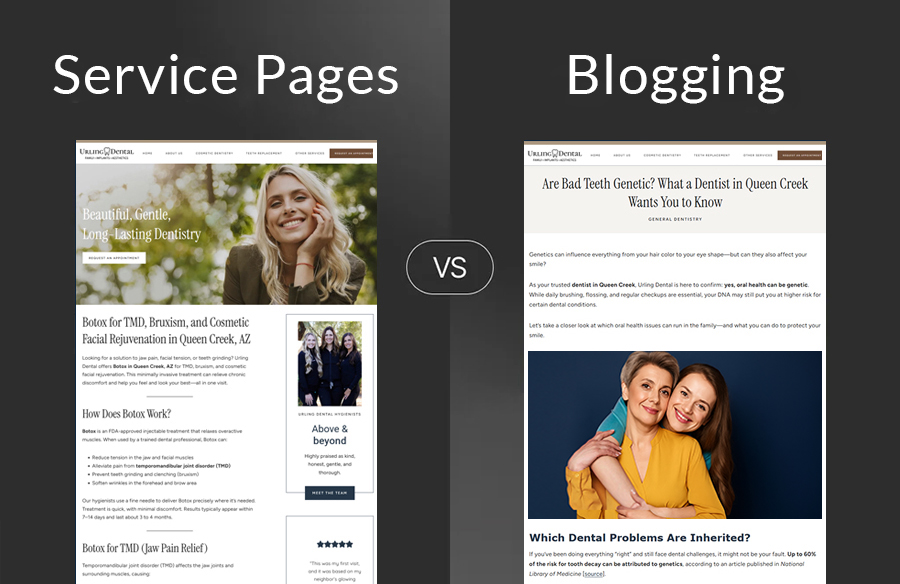
Blog posts build authority and visibility. Service pages drive conversions and bookings. If you rely on one without the other, your dental SEO strategy is incomplete.
In this post, we’ll break down how each works, what they’re best for, and how to combine them to dominate Google and attract new patients.
Key Takeaways
- Blogging builds traffic and topical authority.
- Service pages convert visitors into patients.
- Blog posts target broad questions and educational intent.
- Service pages target high-intent, service-specific keywords.
- The best Dental SEO strategy includes both — working together.

See How Our Agency Can Help You Attract More Patients
- SEO — dominate Google and Local Map searches.
- Website Design — convert traffic into booked appointments.
- Content Marketing — we create content that gets traffic.
Why This Debate Matters
Google doesn’t just look at your homepage — it analyzes every page on your website to determine what you’re known for and who you help.
Blog posts help you show expertise across many topics. Service pages help you monetize that expertise by turning visitors into appointments.
If your site only has one of the two, you’ll either:
- Get traffic but no patients, or
- Get conversions but no visibility.
The magic happens when you strategically link both.
What Blogging Does for Dental SEO
1. Builds Authority
Every blog post you publish is another opportunity to prove your expertise. When Google sees consistent, in-depth educational content, it views your practice as an authoritative source.
For example:
A blog titled “How Often Should You Replace Your Toothbrush?” may not drive instant bookings, but it strengthens your topical authority and helps you rank for more queries over time.
To write blogs that rank in informational searches, use this guide: How to Write SEO-Friendly Blog Posts for Dentists.
2. Targets Long-Tail Keywords
Blogs capture “discovery” searches — when users are in research mode.
Examples:
- “What age should kids start seeing a dentist?”
- “Does teeth whitening damage enamel?”
- “How much does Invisalign cost in Arizona?”
These longer searches are easier to rank for and bring in top-of-funnel traffic that can later convert.
3. Earns Backlinks and Mentions
Helpful blog posts are more likely to be cited by other websites. That’s huge for SEO — backlinks remain one of Google’s strongest ranking signals.
Educational posts, infographics, or data-driven studies can attract organic backlinks naturally.
4. Increases Time on Site
Blogs that answer questions and include visuals keep visitors engaged longer. That tells Google your content is valuable, which improves your rankings sitewide.
What Service Pages Do for Dental SEO
Service pages are your conversion engines — they’re designed to rank for high-intent searches and turn visitors into patients.
Examples include:
- /services/teeth-whitening/
- /services/invisalign/
- /services/dental-implants/
Each one targets a specific service + city keyword combination.
If you want to create service pages that convert, follow How to Create Dental Service Area Pages That Convert.
1. Converts High-Intent Visitors
People searching for “Invisalign Gilbert” or “Emergency Dentist in Queen Creek” are ready to take action.
A well-optimized service page gives them exactly what they need to book:
- Benefits and features
- Before-and-after photos
- Pricing or insurance details
- Testimonials
- A clear call to action
2. Strengthens Local Relevance
Service pages help you show up in local map results by emphasizing city keywords and schema data.
Each page reinforces your geographic authority, especially when combined with a strong Google Business Profile.
3. Improves Conversion Rates
Unlike blogs, service pages remove distractions. Their purpose is singular — drive calls, bookings, or consultations.
Conversion-focused dental service pages often achieve 5–10% higher conversion rates than general service pages.
The Winning Combination: Blog + Service Page Funnel
Here’s how the two work together in a smart SEO strategy:
| Stage | Page Type | Keyword Intent | Goal |
| Awareness | Blog Post | Informational (“What is Invisalign?”) | Build trust & traffic |
| Consideration | Blog Post + Internal Links | Comparative (“Invisalign vs Braces”) | Educate & pre-sell |
| Decision | Service Page | Transactional (“Invisalign Gilbert”) | Convert into a booking |
Example flow:
1. Blog post — “Invisalign vs Braces: Which Is Better?”
2. Internal link → /services/invisalign/
3. Visitor reads, clicks, and books.
That’s SEO-fueled patient conversion.
Build authority across both blogs and service pages with the strategy in How to Use E-E-A-T to Boost Dental SEO Credibility.
How to Optimize Both for Maximum SEO
- Use Consistent Branding
Keep your logo, navigation, and tone unified across both content types.
- Cross-Link Strategically
Add CTAs from blog posts to related service pages — and include “Learn More” links from service pages to relevant blogs.
- Include FAQs and Schema
Both page types benefit from FAQ content — and structured data helps both rank better.
- Measure Performance Separately
Track blogs for traffic and engagement; track service pages for conversion.
- Repurpose Blog Content into Landing Page Enhancements
Turn snippets, stats, or quotes into visual modules or testimonials on your service pages.
Example: Teeth Whitening
| Page Type | URL | Purpose | Keyword Focus |
| Blog | /blog/teeth-whitening-cost/ | Educate | “How much does teeth whitening cost?” |
| Blog | /blog/teeth-whitening-vs-home-kits/ | Compare | “Best teeth whitening methods” |
| Service | /services/teeth-whitening/ | Convert | “Teeth whitening Gilbert” |
This trifecta captures researchers, comparers, and buyers — dominating every stage of the funnel.
Common Mistakes Dentists Make
❌ Using only a single “Services” page instead of one per service.
❌ Treating blogs like ads (too salesy).
❌ Not linking blogs to service pages.
❌ Ignoring metadata and schema.
❌ Writing content that’s too short to rank.
Your blog attracts; your sales pages convert. Together, they make Google — and your patients — happy.
FAQs
Conclusion: Blog to Educate — Service Pages to Convert
Dental SEO isn’t about choosing between blogs or service pages — it’s about using both strategically. Blogs earn visibility by answering patient questions and building authority, while service pages turn that trust into booked appointments.
When your educational content guides readers toward action-focused service pages, you create a complete SEO ecosystem — one that attracts, informs, and converts.
Ready to balance content that ranks and drives revenue? Book a Free Dental SEO Strategy Call →
