
What Makes a Dental Website SEO-Friendly
Ever wonder why some dental websites show up everywhere — while others with great designs barely rank?
That’s because being pretty doesn’t equal being optimized.
An SEO-friendly dental website blends great design, fast performance, technical precision, and conversion psychology — turning Google visitors into booked patients.
Let’s unpack what truly makes a dental website SEO-friendly — and how to make yours one of them.
Key Takeaways
- SEO-friendly dental websites combine design, structure, and speed.
- Core elements: technical SEO, on-page optimization, mobile usability, and internal linking.
- Site architecture, schema markup, and user experience directly affect rankings.
- Google rewards speed, accessibility, and trust signals.
- Every SEO-friendly website should convert visitors into appointments.

See How Our Agency Can Help You Attract More Patients
- SEO — dominate Google and Local Map searches.
- Website Design — convert traffic into booked appointments.
- Content Marketing — we create content that gets traffic.
Why a Dental Website’s SEO Matters
When patients search “dentist near me” or “cosmetic dentist in Gilbert,” they don’t scroll — they click the first trusted result.
If your site isn’t optimized for both humans and search engines, it’s invisible.
SEO-friendly design doesn’t just boost rankings — it improves:
- Click-through rate (by 37% with strong titles and meta descriptions)
- Patient trust (with security, HTTPS, and professional visuals)
- Conversion rate (by 20–40% with clear CTAs and fast load speeds)
What Defines an SEO-Friendly Dental Website
Google doesn’t just crawl words — it evaluates how your entire site behaves.
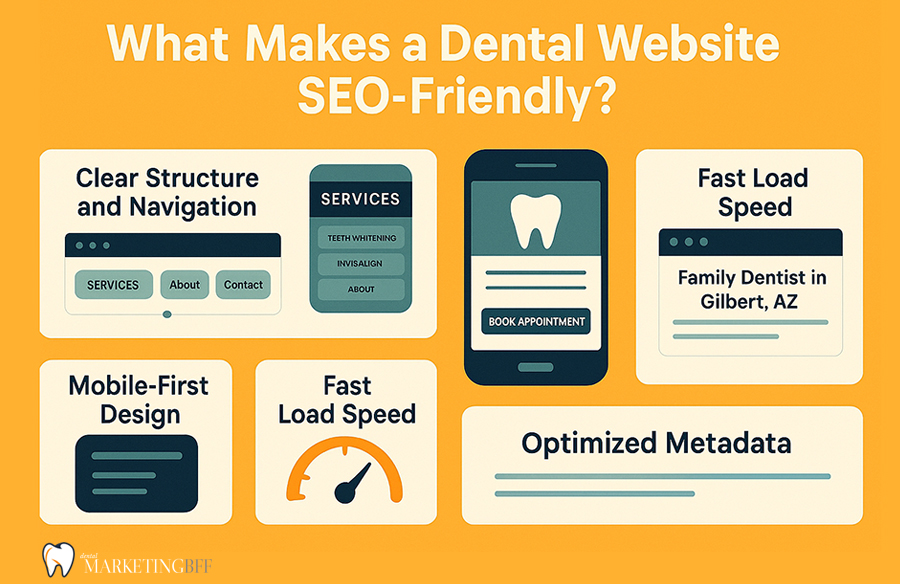
Here’s what separates a true SEO-friendly site from an average one:
1. Clear Structure and Navigation
Your site should be organized by service type, not designer preference.
- /services/teeth-whitening/
- /services/invisalign/
- /about/
- /contact/
Breadcrumbs help users (and Google) navigate.
A big part of an SEO-friendly website is how your pages are organized. For a deeper dive into this, read SEO Website Structure for Dental Clinics.
2. Mobile-First Design
Over 70% of dental searches happen on phones. Google indexes the mobile version first — so your site must load quickly and look flawless on all screen sizes.
Check: tap-to-call buttons, compressed images, responsive layout.
3. Fast Load Speed
- A slow site frustrates users and lowers rankings.
- Use tools like Google PageSpeed Insights or GTmetrix to measure.
- Ideal load time: under 2.5 seconds.
- Compress large images, remove unused plugins, and enable caching.
Speed is also non-negotiable for both Google and your patients. If your site feels slow, walk through How to Improve Page Speed for Your Dental Site.
4. Optimized Metadata
Your title tag, meta description, and headers should include your service + city keywords. Example:
Title: Family Dentist in Gilbert, AZ | Gentle Dental Care for Every Smile
Meta: Looking for a trusted dentist in Gilbert? We create bright, healthy smiles with advanced care.
5. Schema Markup
Use LocalBusiness, Dentist, and FAQ schema so Google understands your business.
6. Strong Internal Linking
Guide Google and visitors through your content using descriptive anchors, for example: Learn more about teeth-whitening.
7. Conversion-Focused Layout
SEO brings traffic — but design converts it. Key elements:
- Prominent “Book Appointment” button
- Before-and-after gallery
- Reviews/testimonials block
- FAQ section
- Lead capture forms above the fold
Once you’ve nailed the basics, you can give Google even more clarity by following How to Add Schema Markup for Dentists.
10 Strategies to Make Your Dental Website SEO-Friendly
- Use HTTPS for security.
- Write 1,000+ words per main service page.
- Optimize every image with descriptive alt text.
- Ensure your sitemap.xml is submitted in Google Search Console.
- Include your NAP (Name, Address, Phone) in the footer.
- Link between related services.
- Create a blog with educational content.
- Embed your Google Map.
- Add internal FAQs.
- Update content at least twice per year.
Common SEO Pitfalls for Dental Websites
- Keyword stuffing (hurts readability)
- Duplicate pages across locations
- Missing or broken meta descriptions
- Slow mobile experience
- Stock photos without alt text
- No SSL certificate
Each of these common SEO pitfalls weakens trust and rankings for your dental website.
FAQs
Conclusion: Build a Website That Ranks — and Converts
An SEO-friendly dental website does more than look good — it performs. When your site is fast, structured, and optimized for both Google and your patients, it becomes your most valuable marketing asset.
By combining technical SEO, local optimization, and conversion-focused design, you’ll not only rise in search rankings but also turn those clicks into booked appointments.
Ready to see how SEO-friendly your website really is? Book a Free Dental SEO Strategy Call →
